
Actually Free vs Trial Credits (Different Things)
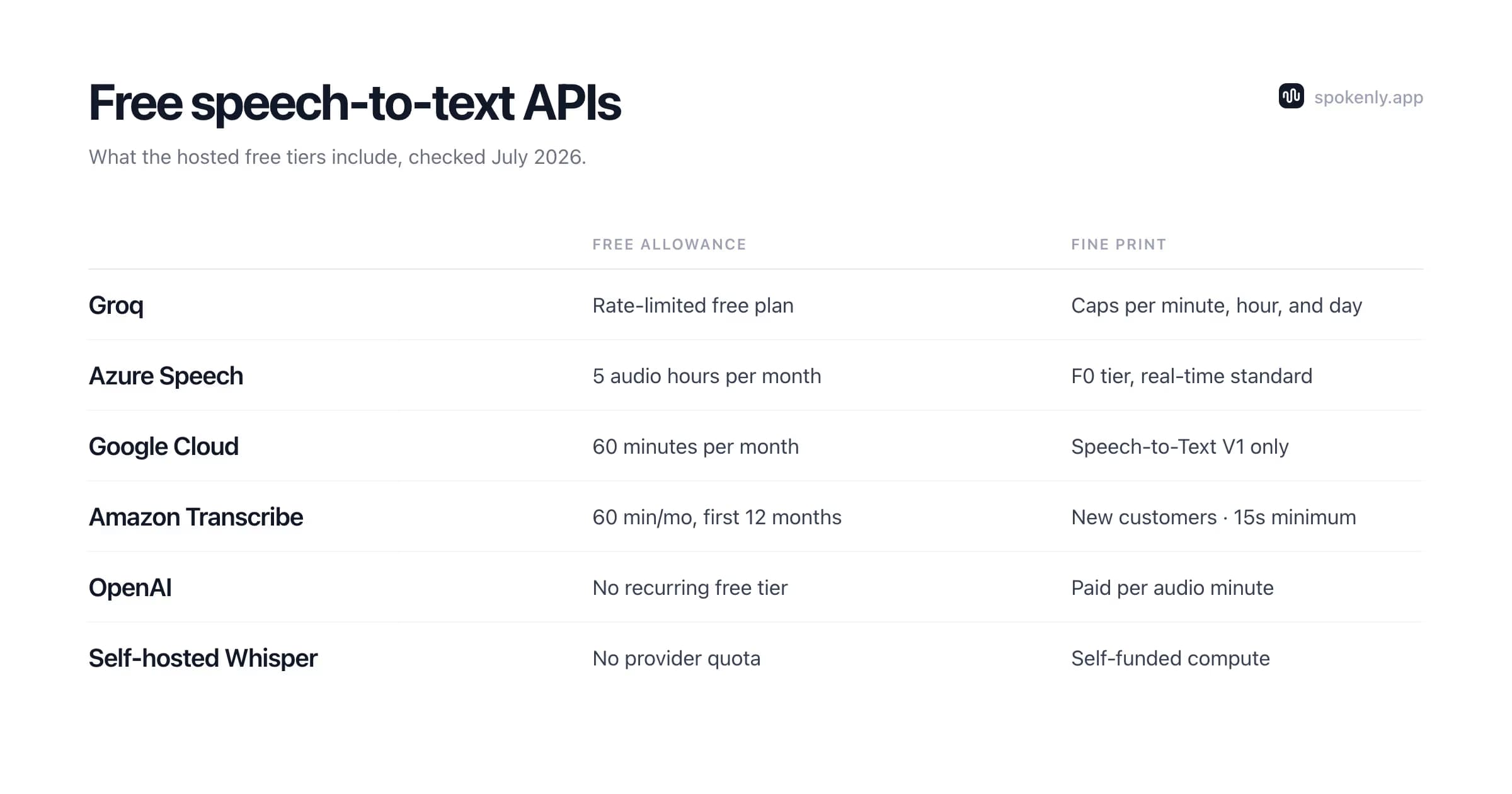
The word free can refer to four different constraints. Treat them separately before choosing an API:
Rate-limited Free plan
Groq lets an account use hosted Whisper without billing until it reaches request or audio limits. This is useful for prototypes, but it is not production capacity.
Recurring capped allowance
Azure F0 includes 5 hours/month for real-time standard transcription. Google's 60 free monthly minutes belong to Speech-to-Text V1, not V2.
Time-limited new-customer allowance
Amazon Transcribe includes 60 minutes/month during the first 12 months for eligible new AWS customers. It is not a permanent account quota.
No standing hosted allowance
OpenAI publishes per-minute estimates for its transcription models but does not list a recurring hosted transcription free tier.
Free model, self-funded compute
Whisper is open source, but a self-hosted service still consumes CPU or GPU time, storage, bandwidth, engineering time, and monitoring.
Provider Limits Compared
Groq
- Free allowance
- Rate-limited Free plan for Whisper Large V3 and Large V3 Turbo
- Paid rate
- $0.04 per audio hour for Turbo and $0.111 per audio hour for Large V3
- Operational limit
- Free plan: 20 requests/minute, 2,000/day, 7,200 audio seconds/hour, 28,800/day, and 25 MB uploads
Microsoft Azure Speech
- Free allowance
- F0 includes 5 audio hours/month for real-time standard speech-to-text
- Paid rate
- Move to S0 for paid usage; price depends on region, model, and processing mode
- Operational limit
- The 5-hour F0 quota applies to real-time standard transcription; concurrency and file limits are separate
Amazon Transcribe
- Free allowance
- 60 audio minutes/month during the first 12 months for eligible new AWS customers
- Paid rate
- Usage continues at the applicable regional tier rate after the allowance
- Operational limit
- Standard transcription is billed per second with a 15-second minimum per request
Google Cloud Speech-to-Text
- Free allowance
- 60 free minutes/month on V1 only; V2 does not include that allowance
- Paid rate
- V2 standard recognition starts at $0.016/min; dynamic batch is $0.003/min
- Operational limit
- Billing rounds each request to one-second increments; API version, model, channels, and processing mode affect cost
OpenAI
- Free allowance
- No standing transcription free tier
- Paid rate
- gpt-4o-mini-transcribe is estimated at $0.003/min and gpt-4o-transcribe at $0.006/min
- Operational limit
- File constraints and account rate limits are separate from per-minute price; inspect current project limits before launch
Web Speech API
No API key or metered developer bill. It is tied to browser support, offers no provider-neutral service guarantee, and may use remote or supported experimental on-device recognition. Use it for short browser interactions, not portable backend infrastructure.
Self-hosted Whisper
No provider quota. Throughput, latency, concurrency, and cost are determined by the hardware and serving stack you operate.
Provider pricing is not a quality ranking. Accent coverage, noisy audio, names, diarization, timestamps, and endpointing can change the best choice. The Parakeet vs Whisper comparison covers local model trade-offs.
Methodology and Date of the Snapshot
This snapshot was verified on July 13, 2026 against the five linked provider pricing and quota pages. Rates were normalized to an audio minute or hour where the provider published that estimate. Rate-limited plans, recurring allowances, time-limited new-customer offers, and self-hosted software are labeled separately because they are not interchangeable.
No private benchmark, latency race, or accuracy test was run for this update. Published speed factors are therefore not used to rank providers. Before launch, test the same representative audio against each candidate and record word errors, time to first partial transcript, time to final transcript, speaker labels, and total billed duration.
Hosted Free Allowances and Their Expiry
Groq: hosted Whisper with rate limits
Groq exposes an OpenAI-compatible transcription endpoint for Whisper Large V3 and Large V3 Turbo. The Free plan currently lists 20 requests per minute, 2,000 requests per day, 7,200 audio seconds per hour, and 28,800 audio seconds per day for both models. Free uploads are capped at 25 MB, and every request is billed or counted at a minimum of 10 seconds. Those constraints matter more than the headline hourly allowance for apps that send many short clips.
Azure F0: 5 hours of real-time transcription each month
Microsoft lists 5 audio hours per month for real-time standard speech-to-text on the Azure F0 tier. Treat that as a development quota rather than a production capacity promise: concurrency, file size, request rate, model availability, and region still need separate checks. A workload that exceeds F0 must move to S0 or another provider.
Google Cloud: 60 minutes only on V1
The 60-minute monthly allowance appears in Google's V1 pricing. V2 standard recognition starts at $0.016 per minute from the first minute, while V2 dynamic batch is $0.003 per minute. Choose the API version deliberately instead of assuming that a Google Cloud project receives 60 free V2 minutes.
Amazon Transcribe: 60 minutes/month for the first 12 months
Eligible new AWS customers receive 60 minutes per month for their first 12 months. Standard transcription is billed in one-second increments with a 15-second minimum per request, so four two-second commands can consume a full minute of allowance. After the 12-month period or the monthly quota is exhausted, normal regional pricing applies.
Web Speech API: free inside the browser
Web Speech API can put a microphone into a search box, form, or short note without provisioning a backend key. Browser and platform support vary, remote processing is common, and experimental on-device recognition requires implementation support plus downloaded language packs. Keep a typed fallback and do not base a cross-browser service-level objective on it.
Choose the API by Workload, Not Free Minutes
A useful free tier is one that exercises the same request path the product will use in production. Match the test to the workload before comparing the headline allowance:
Live dictation
Use a native streaming endpoint and measure time to first partial, endpoint detection after silence, reconnect behavior, and simultaneous sessions. A large batch credit does not prove a WebSocket workflow will stay responsive.
Many short voice clips
Check minimum billed duration, requests per minute, and daily request caps. Groq's 10-second minimum and free-plan request limits can matter more than its daily audio-seconds allowance for two-second commands.
Long recordings
Confirm maximum file size and duration, timestamp formats, diarization add-on cost, and asynchronous job retention. Queue uploads and record the provider job ID so a worker restart does not submit the same audio twice.
Browser prototype
Web Speech API avoids key management and a backend, but browser support and recognition mode vary. Keep the microphone state visible, provide typed input, and plan a server API before promising consistent cross-browser behavior.
Sensitive or regulated audio
Check processing region, retention controls, training terms, access logs, deletion behavior, and whether the provider will sign the agreement your organization requires. A zero-dollar request does not remove compliance obligations.
Working API Requests
Groq and OpenAI accept multipart uploads on compatible transcription endpoints. Set the environment variable, replace sample.m4a, and keep API keys on the server rather than in browser JavaScript.
Groq Free plan request
curl https://api.groq.com/openai/v1/audio/transcriptions \
  -H "Authorization: Bearer $GROQ_API_KEY" \
  -F "file=@sample.m4a" \
  -F "model=whisper-large-v3-turbo" \
  -F "response_format=json"
OpenAI lower-cost transcription request
curl https://api.openai.com/v1/audio/transcriptions \
  -H "Authorization: Bearer $OPENAI_API_KEY" \
  -F "file=@sample.m4a" \
  -F "model=gpt-4o-mini-transcribe"
A production upload path also needs file-type validation, request timeouts, retry handling for 429 and transient 5xx responses, idempotency around job creation, and chunking for files beyond the provider's current limit. Never retry authentication or malformed-request errors blindly.
Not Free, but Close: OpenAI
OpenAI's hosted transcription has no standing free allowance. Its current pricing estimate is $0.003 per minute for gpt-4o-mini-transcribe and $0.006 per minute for gpt-4o-transcribe. At the published estimate, one hundred audio hours cost about $18 or $36 before any surrounding storage, upload, or application costs.
Price alone does not decide between the two. Run representative names, accents, noise, languages, and long pauses through both, then compare error rate and total request latency. Use the mini model when its output meets the threshold instead of assuming that the higher-priced model is required.
Unlimited Provider Quota, but Self-Funded Compute
Every hosted allowance has a provider ceiling. Running an open-source Whisper implementation removes that quota and keeps audio inside infrastructure you control. It does not make compute free: the bill moves to hardware, electricity, storage, bandwidth, deployment, monitoring, and engineering time.
Measure real-time factor on the exact CPU, GPU, or Neural Engine you will deploy. A service that processes one hour of audio in ten minutes has a real-time factor of 0.17, but simultaneous uploads can still create a queue. Concurrency requires enough workers and memory, plus backpressure so a traffic spike does not exhaust the machine.
The local Whisper setup covers installation, while the Whisper model size comparison helps match a checkpoint to available memory. A desktop app can package the same local workflow without exposing a server endpoint.
Using Free API Keys in Apps (BYOK)
The free tiers above are not just for writing code. BYOK apps (bring your own key) let you paste an API key and route the app's transcription through your own account:
- 1Create a key in the provider console and set a conservative account spending limit where the provider supports one.
- 2Paste it into a BYOK dictation app. Spokenly accepts transcription keys for OpenAI, Deepgram, and Groq on macOS, Windows, Linux, and iOS.
- 3Choose the provider in the app. Cloud audio is then processed against your provider account and counts toward that account's allowance, rate limits, and data terms.
Spokenly is free with BYOK or local models. Pro is $9.99 per month or $99.99 per year for managed cloud transcription and hosted AI, so it is the route for people who do not want to maintain provider keys.
Free-Tier Fine Print Worth Knowing
Rate limits
Requests per minute, audio seconds per hour, and daily request caps can stop a workload before its monetary allowance is consumed. Read 429 response headers and add bounded exponential backoff.
Concurrency
A connection limit is not the same as requests per minute. Streaming apps need enough simultaneous sessions, while batch systems need a queue and worker cap.
Latency
Published model speed excludes microphone buffering, upload time, routing, queueing, endpoint detection, and text insertion. Measure first partial and final transcript separately.
Billing granularity
Providers may round short requests or impose a minimum billed duration. Thousands of two-second clips can cost more than the same audio grouped into longer requests.
File and duration limits
Validate format and size before upload. Chunk long recordings with overlap, preserve timestamps, and deduplicate words around boundaries.
Data handling
Free and paid plans can have different retention or training terms. Review the provider's current data controls before sending client, medical, legal, or confidential audio.
Offer changes
Store the verification date next to pricing in product documentation and recheck it before launch. A free allowance is not a contractual capacity guarantee.
FAQ
Is the OpenAI Whisper API free?
No. OpenAI has no standing free allowance for its hosted transcription models. Its published estimates are $0.003 per minute for gpt-4o-mini-transcribe and $0.006 per minute for gpt-4o-transcribe. The open-source Whisper model can still be self-hosted, with hardware and operations as the cost.
Which speech-to-text APIs have recurring free allowances?
Groq offers a rate-limited Free plan. Azure Speech F0 includes 5 real-time audio hours per month, while Google Cloud's recurring 60 free minutes apply to Speech-to-Text V1, not V2. The browser Web Speech API needs no developer key. Self-hosted Whisper has no provider quota, but compute and operations are self-funded.
How far do the free allowances actually go?
Azure F0 provides up to 5 real-time audio hours each month. Google V1 provides 60 minutes each month. Amazon Transcribe provides 60 minutes per month only during the first 12 months for eligible new AWS customers, and its 15-second minimum means short clips consume allowance faster than their actual duration.
What is the best free API for real-time transcription?
For a browser-only prototype, Web Speech API is the shortest path. For a server-backed prototype, compare Groq's rate-limited Free plan with Azure F0's 5 real-time hours per month and Amazon Transcribe's time-limited new-customer allowance. Test endpointing latency, rate limits, and concurrent sessions with your own audio before choosing.
Can I use these free API keys in dictation apps instead of writing code?
Yes. BYOK means the app sends transcription requests through your own provider account. Spokenly accepts keys for OpenAI, Deepgram, and Groq. Usage still counts against the provider's current allowance and rate limits, and the provider handles cloud audio under its own data terms.
Is there a free speech-to-text API without a credit card?
Groq offers a Free plan, while self-hosted Whisper needs no provider account. Azure and AWS account setup can require billing details even when usage stays inside a free allowance. Account requirements can change, so verify the signup screen before committing a product to one offer.
What about the Web Speech API in browsers?
It needs no developer key and is useful for short browser interactions. Support, language coverage, and processing mode vary by browser. Recognition may use a remote service, while experimental on-device recognition is available only in supported implementations. It is not a portable replacement for a server API.
Ready to try Spokenly?
Free to use with local models. No account required.
Download SpokenlyRead next