
What Is GPT-Transcribe
GPT-Transcribe is the speech-to-text model OpenAI released on July 28, 2026, alongside its streaming counterpart gpt-live-transcribe. It transcribes completed audio files, streams partial text while a file is processing, and handles committed turns in Realtime sessions. OpenAI's transcription guide now opens with one instruction: start with gpt-transcribe. Whisper had held that spot since 2022.
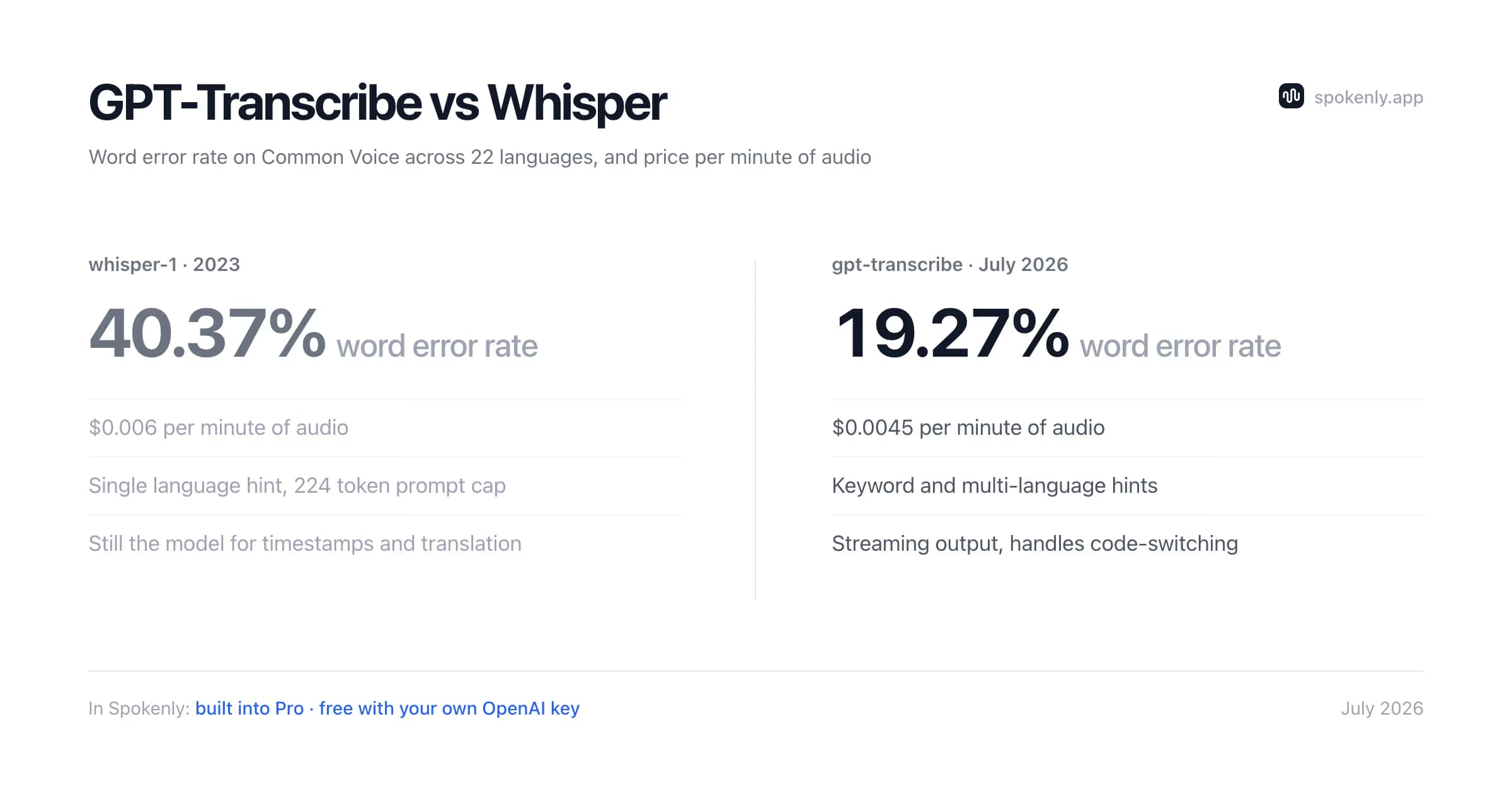
Accuracy is where the difference shows. On OpenAI's launch benchmark, Common Voice across 22 languages, word error rate drops from 40.37 percent with whisper-1 to 19.27 percent with GPT-Transcribe. That is less than half the mistakes on identical audio. The hint system targets the terms that dictation gets wrong in practice: domain vocabulary, multilingual audio, and sentences that switch language midway.
The context features run through three request fields on the same /v1/audio/transcriptions endpoint Whisper uses: prompt for a free-form description of the recording, keywords for literal terms you expect to hear, and languages for expected input languages. The response reports which languages the model actually detected. It accepts files up to 25 MB in mp3, mp4, m4a, wav, webm, mpeg, and mpga.
GPT-Transcribe Pricing
File transcription with GPT-Transcribe costs $0.0045 per minute of audio, per the official model page. That is 25 percent below the $0.006 per minute that both whisper-1 and gpt-4o-transcribe charge, so the accuracy upgrade also costs less. An hour of audio runs about 27 cents; three hours of dictated audio in a day stays under a dollar. The realtime model is the expensive one: gpt-live-transcribe bills $0.017 per minute of session audio, about $1 per hour.
gpt-transcribeDefault for files and dictation · $0.0045/min
Top accuracy tier, keyword and language hints, streaming output
gpt-live-transcribeReal-time streaming · $0.017/min
Transcript deltas over WebSocket, tunable toward speed or stability
gpt-4o-transcribePrevious generation · $0.006/min
March 2025 model, still served for existing integrations
gpt-4o-mini-transcribePrevious budget option · $0.003/min
Cheapest hosted option in the lineup
whisper-1Timestamps and translation · $0.006/min
Only model with word timestamps and the translation endpoint
There is no free tier for any hosted OpenAI transcription model. For zero cost rather than maximum accuracy, the roundup of free speech-to-text APIs covers what Groq, Deepgram, and others give away, and Whisper run locally costs nothing at all.
GPT-Transcribe vs Whisper and GPT-4o
Against whisper-1, the new model halves the word error rate, costs 25 percent less, streams output for files, takes richer context than Whisper's 224-token prompt cap allows, and accepts multiple language hints instead of a single language field. Whisper keeps two specialist jobs. It is still the only hosted OpenAI model that returns word and segment timestamps for subtitle files, and the only one on the translation endpoint that turns foreign-language audio into English text.
GPT-Transcribe succeeds gpt-4o-transcribe, the March 2025 model, at a lower price and with a bigger context toolkit: keyword lists, several language hints at once, and detected-language output on top of the prompt field the 4o models already supported. The 4o generation remains available for existing integrations, and gpt-4o-transcribe-diarize remains the pick when speaker labels matter. New projects have no reason to start on gpt-4o-transcribe.
One caveat applies to all of them: these are cloud models. Audio leaves your machine and is processed on OpenAI's servers. For anyone that rules out, the Parakeet vs Whisper comparison shows what on-device engines achieve with no network connection at all.
How to Use GPT-Transcribe in Spokenly
Spokenly supports GPT-Transcribe on macOS, iOS, and Windows from day one, through two routes. Either way, the model ends up bound to a system-wide hotkey: press it, speak, and the transcript lands at the cursor of whatever app has focus.
Route 1: built into Spokenly Pro
Select GPT Transcribe in Spokenly's model list, in the Most Accurate category. No OpenAI account, no API key, no per-minute billing; usage is covered by the Pro subscription. Audio on this route is still cloud-processed, by Spokenly's backend and OpenAI; for dictation that never touches a server, Spokenly's local models with Local Only Mode keep everything on-device.
Route 2: bring your own API key
Bring-your-own-key works on Spokenly's free plan with no word caps. Create an API key in your OpenAI dashboard, open Spokenly's model settings, choose the OpenAI provider, and paste the key. Spokenly preselects gpt-transcribe, so nothing else needs configuring. You pay OpenAI directly: $0.0045 per minute of audio with the file model, $0.017 per minute with realtime streaming.
Spokenly layers its own features on top of either route: automatic language detection across 100+ languages, custom word replacements for terms the model still misses, and AI formatting prompts that strip filler words. MCP integration pipes the same dictation into Claude Code, Cursor, and Codex.
Real-Time Dictation with GPT-Live-Transcribe
The second launch model, gpt-live-transcribe, targets live audio. Instead of waiting for a finished recording, it holds a WebSocket session and emits transcript deltas as you speak, with latency you can tune toward speed or stability. OpenAI lists it in the same top performance tier as the file model, at $0.017 per minute of session audio.
In Spokenly, enable streaming on the OpenAI provider and dictation switches to gpt-live-transcribe automatically: words appear on screen while you are mid-sentence rather than after you stop. For long-form dictation, seeing the text as it is spoken lets you catch a misheard term in the moment instead of after the fact. Anyone who configured the interim gpt-realtime-whisper model keeps a working setup, while new configurations select the live model by default.
Picking the Right OpenAI Model
Everyday dictation and notes
gpt-transcribe. OpenAI's recommended default: top accuracy tier at the lowest per-minute price of the current pair, with keyword hints for jargon, names, and product terms.
Live captions and voice agents
gpt-live-transcribe. It streams partial text with tunable latency, so the transcript keeps up with the speaker.
Meeting recordings with multiple speakers
gpt-4o-transcribe-diarize. It labels who said what and accepts short reference clips to map segments onto known speakers.
Subtitles, captions files, or English translation
whisper-1. It is the only OpenAI-hosted model with word-level timestamps and the translation endpoint.
Private or offline transcription
Skip the cloud entirely. Spokenly's local Parakeet and Whisper models run on your machine for free, with no audio leaving the device.
GPT-Transcribe FAQ
What is GPT-Transcribe?
GPT-Transcribe is OpenAI's speech-to-text model released on July 28, 2026. It converts audio files and streamed audio into text and is now the model OpenAI recommends for transcription, ahead of whisper-1, gpt-4o-transcribe, and gpt-4o-mini-transcribe. It accepts context prompts, keyword hints, and multiple language hints, and it reports which languages it detected in the audio.
How much does GPT-Transcribe cost?
OpenAI charges $0.0045 per minute of audio for GPT-Transcribe file transcription, which is 25 percent less than the $0.006 per minute of whisper-1 and gpt-4o-transcribe. The real-time streaming model gpt-live-transcribe costs $0.017 per minute of session audio. One hour of file transcription costs about $0.27.
Is GPT-Transcribe better than Whisper?
On OpenAI's launch benchmark, GPT-Transcribe roughly halves the word error rate of whisper-1 on Common Voice across 22 languages, from 40.37 percent to 19.27 percent, and it costs 25 percent less per minute. Its keyword and language hints also target domain terms, multilingual audio, and code-switching. Whisper still has two jobs GPT-Transcribe does not do: word-level timestamps and the translation endpoint.
What is the difference between GPT-Transcribe and GPT-4o Transcribe?
GPT-4o Transcribe launched in March 2025 as a speech-to-text model built on GPT-4o. GPT-Transcribe is its successor: cheaper at $0.0045 versus $0.006 per minute, and equipped with keyword lists, multiple language hints, and detected-language output on top of the prompt field the 4o models already supported. OpenAI now points new transcription projects to gpt-transcribe.
What is gpt-live-transcribe?
gpt-live-transcribe is the streaming companion model, built for live dictation and voice agents. It listens to a microphone or call over a WebSocket connection and returns transcript deltas with tunable latency. It costs $0.017 per minute of session audio, about $1 per hour. Spokenly uses it when you enable streaming on the OpenAI provider, so words appear while you speak.
Can I use GPT-Transcribe for free?
The model itself is a paid OpenAI API, billed per minute with no free allowance. Spokenly's bring-your-own-key support is free though: add your OpenAI API key and you pay OpenAI about $0.27 per hour of transcribed audio, or about $1 per hour with the realtime streaming model, with no Spokenly subscription required. For zero cost, Spokenly's local Parakeet and Whisper models run on-device and are free without limits.
Which languages does GPT-Transcribe support?
GPT-Transcribe is multilingual and handles code-switching, where the speaker changes language mid-sentence. You can pass several expected languages as hints using ISO 639 codes such as en or es, plus regional zh locale codes like zh-cn, and the response lists the languages the model actually detected. OpenAI's launch benchmark covers 22 languages on Common Voice; a full supported-language list is not published.
Does Spokenly support GPT-Transcribe?
Yes. Spokenly Pro includes GPT Transcribe as a built-in model with no API key needed. On the free plan, add your own OpenAI API key and Spokenly uses gpt-transcribe as the default model for the OpenAI provider, including gpt-live-transcribe for real-time streaming. Both routes work on macOS, iOS, and Windows.
Does GPT-Transcribe support speaker labels or timestamps?
No. For speaker diarization OpenAI provides gpt-4o-transcribe-diarize, which returns segments labeled by speaker. For word or segment timestamps, whisper-1 remains the only OpenAI-hosted option via timestamp_granularities. GPT-Transcribe focuses on plain, accurate transcript text.

