
Which Parakeet Model to Use
Dictation on an Apple silicon Mac or iPhone
Parakeet Ultra
Smallest multilingual download
Parakeet Redux
Live English dictation
Parakeet Unified 0.6B or Realtime EOU 120M
Windows or Linux PC
Parakeet V3, or V2 for English only
Server with an NVIDIA GPU
Parakeet Ultra
CPU-only server
Parakeet Redux
What the Parakeet Model Names Mean
A name like parakeet-tdt-0.6b-v3 reads as decoder type, size, then version or language:
TDT, RNN-T, CTC
The decoder. TDT (Token-and-Duration Transducer) predicts each token together with how many audio frames it covers, so it can skip frames and decode quickly. RNN-T is the classic transducer that TDT extends. CTC is a simpler decoder. Hybrid TDT-CTC checkpoints include both TDT and CTC decoders.
0.6B, 1.1B, 110M
The parameter count, with B for billion and M for million.
V2, V3
Generations of the 0.6B TDT model.
ja, da-dk, Vietnamese
A language suffix marks a checkpoint trained for one language or language pair.
The NVIDIA Parakeet Model Family
NVIDIA trains Parakeet models with its NeMo toolkit. Each checkpoint pairs a FastConformer encoder, which converts audio into acoustic features, with a decoder that maps those features to text. NVIDIA has published more than a dozen Parakeet checkpoints on Hugging Face. These are the six newest general-purpose models:
Parakeet TDT 0.6B V2
NVIDIA, May 2025
Languages
English
Parameters
600M
Handles up to 24 minutes of audio in one pass with full attention.
Parakeet TDT 0.6B V3
NVIDIA, August 2025
Languages
25 European
Parameters
600M
Handles up to 24 minutes per pass with full attention on an 80 GB A100, or up to 3 hours with local attention.
Parakeet Ultra
Moondream, September 2026
Languages
25 European
Parameters
600M
Post-trained for accuracy.
Parakeet Redux
Moondream, September 2026
Languages
25 European
Parameters
600M
Compressed for size.
Parakeet Unified 0.6B
NVIDIA, April 2026
Languages
English
Parameters
600M
An RNN-T model for whole-recording transcription and streaming, with latency as low as 160 ms.
Parakeet Realtime EOU 120M
NVIDIA
Languages
English
Parameters
120M
Streams text with 80 to 160 ms latency and marks the end of each utterance. No punctuation or capitalization.
Sources: NVIDIA model cards for V2, V3, and Unified, and Moondream's Ultra and Redux release.
Parakeet V2 vs V3
Parakeet TDT 0.6B V2 and V3 share the same design, with punctuation, capitalization, and word-level timestamps. V2 transcribes English only. V3 adds 24 more European languages and detects the spoken language automatically, with no language setting.
Word error rate (WER) counts missed, wrong, and extra words against a reference transcript, so lower is better. NVIDIA's model cards report these English averages on the Open ASR Leaderboard sets:
Parakeet Unified 0.6B, whole recording
5.91%
Parakeet TDT 0.6B V2
6.05%
Parakeet Unified 0.6B, streaming at 1.12 s latency
6.29%
Parakeet TDT 0.6B V3
6.34%
Parakeet Realtime EOU 120M, streaming at 160 ms latency
9.30%
Parakeet Ultra and Redux: Moondream's V3 Variants
Moondream released both models on September 22, 2026. Both keep V3's architecture and tokenizer. A small voice activity detection (VAD) head lets Photon, Moondream's runtime, split long recordings at pauses into chunks of up to 30 seconds.
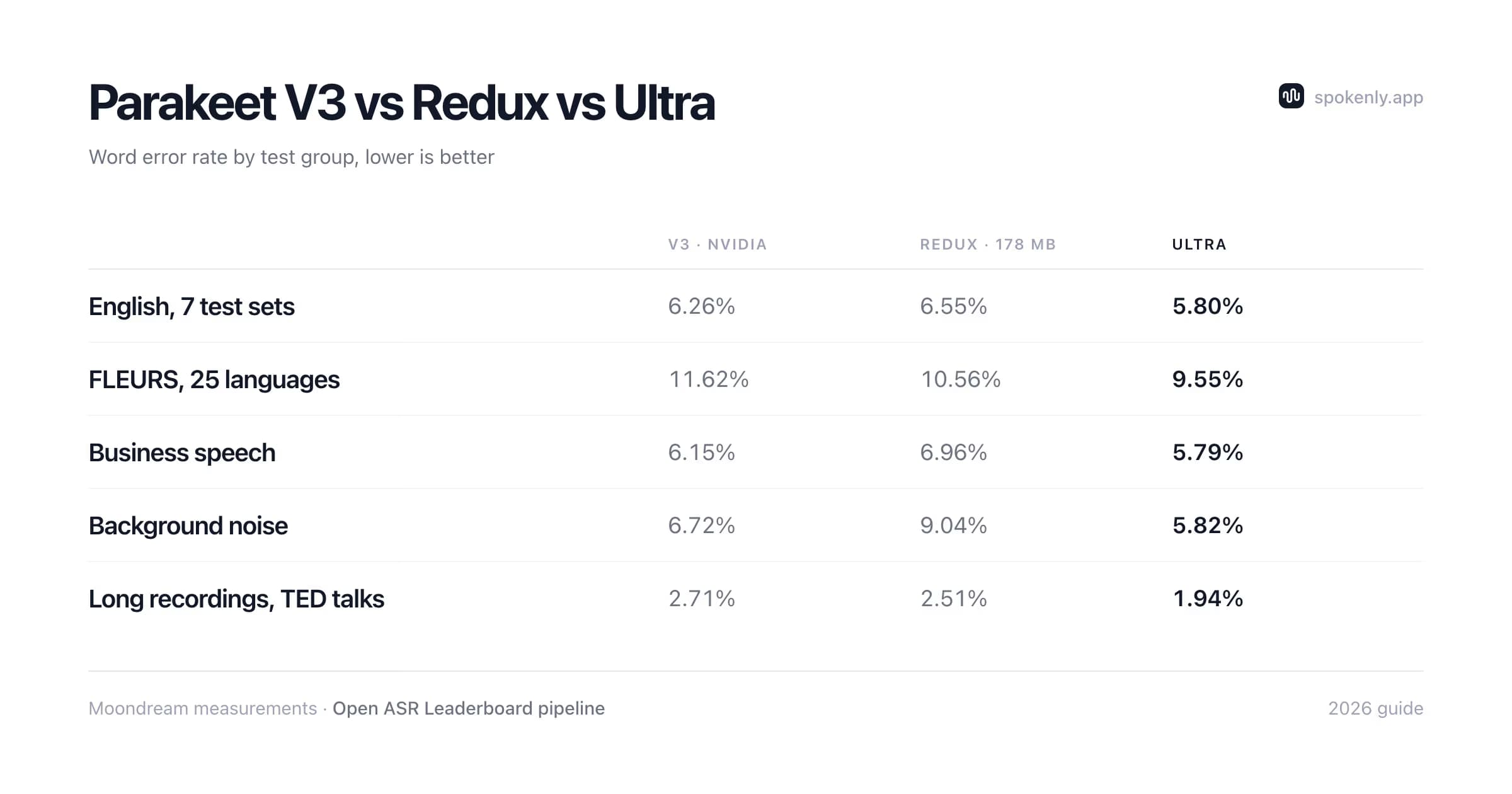
Moondream's English average excludes TED-LIUM and comes from a separate evaluation, so it is not directly comparable with NVIDIA's eight-set average. Business speech covers cleaned AMI meetings, VoxPopuli, and Earnings-22 calls; background noise mixes MUSAN noise into LibriSpeech and FLEURS at 10, 5, and 0 dB. None of the sets is dictation audio. To compare models for dictation, record a few quiet and noisy clips with names and numbers, run each model on them, and count the corrections.
Parakeet Ultra
Parakeet Ultra lowers word error rate in every test group. The largest relative drops are on full TED talks (28%) and 25-language FLEURS (18%), then background noise (13%); the TED result also reflects Photon's segmentation versus NeMo's long-audio path. On one NVIDIA B200 with 128 requests in flight, Photon reached an aggregate 9,743 times real time with Ultra, against 6,005 for V3 in NeMo at batch size 128. That comparison measures model and runtime together.
Parakeet Redux
Parakeet Redux restricts every encoder weight to -1, 0, or +1 (ternary, about 1.58 bits each), shrinking the weights from 1.2 GB at 16-bit to 178 MB. Background noise costs it the most accuracy, and although its FLEURS average is lower than V3's, it has a higher error rate in 11 of the 25 languages, including English, French, German, and Spanish. In Moondream's benchmark, Photon ran Redux at 113 times real time on eight AMD EPYC cores, 2.5 times as fast as parakeet.cpp on the same machine, and at 38 times real time on the CPU of an M2 MacBook Air.
Ultra and Redux on Apple Silicon
Fluid Inference's Core ML builds show the same pattern on an M-series Mac:
LibriSpeech test-other WER
V3
4.12%
Redux
5.12%
Ultra
3.81%
FLEURS WER, 24-language mean
V3
14.81%
Redux
13.06%
Ultra
11.67%
Throughput on the Neural Engine
V3
128.6× real time
Redux
83.9× real time
Ultra
126.7× real time
Redux takes about seven minutes to compile for the Neural Engine on first use on an M-series Mac; later loads take seconds. These results use 100 FLEURS clips per language, 15-second windows, and a simpler text normalizer, so they are not directly comparable with Moondream's.
Parakeet V3 Languages
Parakeet V3, Ultra, and Redux recognize the same 25 European languages:
- Bulgarian
- Croatian
- Czech
- Danish
- Dutch
- English
- Estonian
- Finnish
- French
- German
- Greek
- Hungarian
- Italian
- Latvian
- Lithuanian
- Maltese
- Polish
- Portuguese
- Romanian
- Russian
- Slovak
- Slovenian
- Spanish
- Swedish
- Ukrainian
Accuracy varies widely by language. In Moondream's FLEURS scoring, V3 ranges from 2.61% word error rate in Italian to 35.71% in Greek, and Greek stays the weakest on Ultra at 32.25%. Measured in percentage points, Ultra's largest gains come in Latvian, Slovenian, Lithuanian, and Maltese. For Chinese, Arabic, or other languages outside the list, use Whisper Large V3 Turbo, which covers about 99 languages, or Cohere Transcribe. The Parakeet vs Whisper comparison covers the two model families in detail.
Other Parakeet Models
NVIDIA also offers older English checkpoints, language-specific models, and a multitalker streaming model:
First-generation English checkpoints
CTC 0.6B, RNNT 0.6B, CTC 1.1B, RNNT 1.1B, and TDT 1.1B, built with Suno and published between December 2023 and January 2024. They output lowercase text without punctuation.
Parakeet TDT-CTC 1.1B and 110M
English models with punctuation and capitalization. The 1.1B was trained on 36,000 hours of English speech; the 110M, about 114M parameters, handles up to 20 minutes of audio per pass.
Parakeet TDT-CTC 0.6B (ja)
A Japanese model with punctuation.
Parakeet CTC 0.6B Vietnamese
A Vietnamese and English code-switching model, trained on more than 2,000 hours of Vietnamese speech.
Parakeet RNNT 110M da-dk
A 110M-parameter Danish model.
Multitalker Parakeet Streaming 0.6B
Streams transcripts for several speakers at once, guided by speaker diarization output.
How to Run Parakeet Locally
The route depends on your hardware:
Spokenly
The app route, with no code or model setup.
FluidAudio or parakeet-mlx on a Mac
The open-source FluidAudio Swift package loads Fluid Inference's Core ML builds of Parakeet. The parakeet-mlx Python package ports Parakeet to Apple's MLX framework and reached 37 times real time on an M2 GPU in Moondream's test.
NeMo or Photon on an NVIDIA GPU
NVIDIA NeMo loads V2, V3, and NVIDIA's other checkpoints. Photon loads Ultra and Redux.
Photon, NeMo-Speech.cpp, or ONNX on a CPU
Photon has CPU kernels for Redux: AVX-512 VNNI on x86 and NEON on ARM. For V3, NVIDIA's NeMo-Speech.cpp reads an 8-bit GGUF file, and ONNX Runtime ports such as sherpa-onnx run int8 builds of V2 and V3.
Community MLX, GGUF, and ONNX conversions of Ultra and Redux also appeared on Hugging Face within days of the release.
NVIDIA NeMo
import nemo.collections.asr as nemo_asr

asr_model = nemo_asr.models.ASRModel.from_pretrained(
    model_name="nvidia/parakeet-tdt-0.6b-v3"
)
output = asr_model.transcribe(["meeting.wav"])
print(output[0].text)
parakeet-mlx on a Mac
pip install parakeet-mlx -U
parakeet-mlx meeting.m4a --output-format txt
The command needs ffmpeg and loads mlx-community/parakeet-tdt-0.6b-v3 by default.
Ultra or Redux with Photon
Install the Moondream package with pip install --upgrade "moondream>=2.4.1", then transcribe a file with Redux on the CPU:
import moondream as md

with md.photon("moondream/parakeet-redux", device="cpu") as speech:
    result = speech.transcribe(audio="meeting.m4a")
    print(result["text"])
Set the model to moondream/parakeet-ultra and the device to "cuda" for Ultra on an NVIDIA GPU, or set the device to "mps" for Redux on an Apple GPU. Pass timestamps="word" for word timings.
Parakeet Models in Spokenly
Spokenly's default dictation models run in the cloud, and any of the local Parakeet models below can replace them. Local models are free, work offline once downloaded, and keep the audio on the device. On Mac and iPhone, Spokenly runs Fluid Inference's Core ML builds:
Parakeet Ultra
632 MB
Parakeet Redux
220 MB
NVIDIA Parakeet Unified 0.6B
1.2 GB
NVIDIA Parakeet EOU 120M
85 MB
NVIDIA Parakeet TDT 0.6B V3
496 MB
NVIDIA Parakeet TDT 0.6B V2
496 MB
Ultra is larger than V3 because its Core ML encoder keeps 8-bit weights. Redux needs macOS 15 or iOS 18, and V2 and Unified need Apple silicon on a Mac; on Intel Macs, Spokenly recommends V3. On Windows, Spokenly runs Parakeet V3 (705 MB), V2 (696 MB), and Unified (697 MB) as GGUF builds, on the GPU through Vulkan when one is available. On Linux, V3 (456 MB) and V2 (451 MB) run on the CPU; the Linux speech-to-text guide covers the setup. Turn on Local Only Mode to block internet connections except model downloads while you dictate.
Parakeet FAQ
Is Parakeet free for commercial use?
Parakeet V2, V3, Ultra, and Redux are released under CC BY 4.0, which permits commercial use with attribution. Parakeet Unified and Realtime EOU ship under the NVIDIA Open Model License, and NVIDIA marks both as ready for commercial use.
How big is Parakeet V3?
NVIDIA publishes the V3 weights in fp32, about 2.5 GB. Builds made for apps are quantized and several times smaller.
Is there a Parakeet V4?
Not as of September 2026.